Lone khalid cni
Somnath cni to participate in key commemorative events.
Somnath temple draws 92–97 lakh devotees annually.
Women play a central role at Somnath. The Somnath Temple Trust employs 262 women among 906 employees; in total around 363 women get employment generating about ₹9 crore annually through the templeThis opening verse of the Dwadasha Jyotirlinga Stotram places Somnath in Gujarat, at the very beginning of the twelve sacred Jyotirlingas, signifying its place in India’s spiritual- heritage. It reflects the civilisational belief that Somnath is the foundation of Bharat’s spiritual geography. Located at Prabhas Patan near Veraval in Gujarat, Somnath is not merely a place of worship but a living symbol of India’s civilisational continuity.
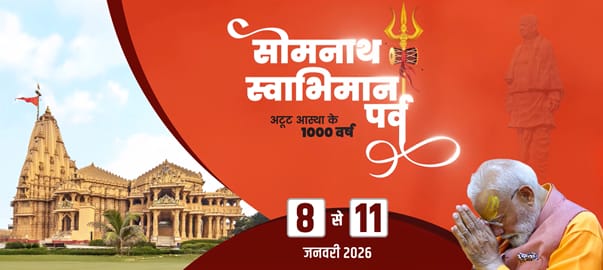
For centuries, Somnath drew the reverence and prayers of millions. It was repeatedly targeted by invaders whose intent was destruction, not devotion. Yet, Somnath’s story is defined by the indomitable courage, faith and resolve of crores of dedicated followers.The Somnath Swabhiman Parv is being organised from 8 January to 11 January 2026 as a national commemoration marking one thousand years since the first recorded attack on the Somnath Temple in January 1026.
The observance has been conceived not as a remembrance of destruction, but as a tribute to resilience, faith and civilisational self-respect. Over centuries, Somnath was repeatedly targeted by invaders whose objective was demolition rather than devotion. Each time, however, the temple was rebuilt through the collective resolve of devotees like Devi Ahilya Bai Holkar. This unbroken cycle of revival has made Somnath a powerful symbol of India’s civilisational continuity.The year 2026 also coincides with seventy-five years since the present Somnath Temple was reopened to devotees on 11 May 1951, following Independence. These two milestones together form the foundation of the Somnath Swabhiman Parv.
During the four-day Parv, Somnath has been transformed into a centre of spiritual activity, cultural reflection and national remembrance. A central feature of the observance is the 72-hour Akhand Omkar chanting, symbolising, unity and collective faith. Alongside this, devotional music, spiritual discourses and cultural programmes are being organised throughout the temple town.
The Somnath Swabhiman Parv stands as a collective expression of pride, remembrance and confidence in India’s Sanatan civilisational journey.The historical roots of Somnath extend deep into ancient Indian tradition. Prabhas Tirtha, where Somnath is located, is associated with Lord Shiva and the worship performed by Chandra, the Moon God. According to tradition, Chandra worshipped Lord Shiva here and was relieved of his curse, giving the site immense spiritual significance.
Over centuries, Somnath witnessed multiple phases of construction, each reflecting the devotion, artistry and resources of its time. Ancient accounts describe successive temples being built here, using different materials, symbolising renewal and continuity. The most turbulent phase of Somnath’s history began in the eleventh century. Cni