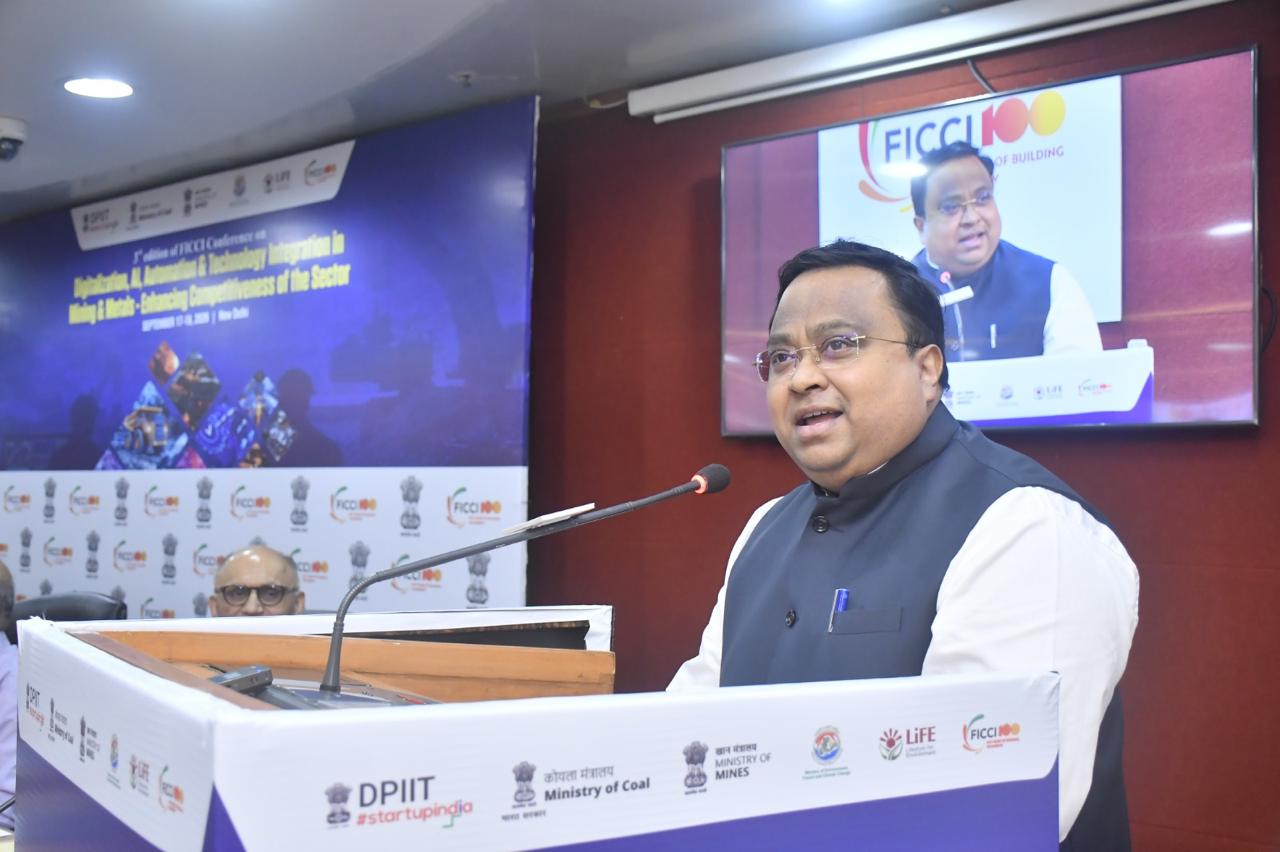
Ishfaq gulzar cni NEW DELHI, CNI NEWS Technology, artificial intelligence, digitalisation and credible data can play a
transformative role in making India’s mining and metals sector more transparent, responsible, productive and globally competitive, said Dr. Sasmit Patra, Hon’ble Member of Parliament, Rajya Sabha and Member, Parliamentary Standing Committee on Coal, Mines & Steel, while addressing the third edition of the FICCI conference on “Digitalisation, AI, Automation and Technology Integration in Mining and Metals.” Dr. Patra said “Technology, including AI and digitalisation, has the potential to transform the mining sector by enabling better monitoring, more transparent decision-making and responsible resource management. If we use technology effectively, it can help us build a safer, more sustainable and more accountable mining ecosystem.”. AI and digital technologies can play a transformative role in mining by helping us monitor operations more effectively, use resources responsibly and generate credible, transparent data. Technology can help the sector become more efficient while strengthening safety, sustainability and trust among all stakeholders added Dr. Patra. He further highlighted that data driven and tech enabled mining will lead to enhance operational, environmental and productive efficiencies, which will in turn enhance the community engagement with the mining industry.
Technology and data can be the bridge between the industry and the society at large, he observed. Highlighting the strategic importance of mining and metals sector, Mr. Dinesh Mahur, Additional Secretary, Defence Production, Ministry of Defence, Government of India, said India’s journey towards becoming a technologically advanced and self-reliant manufacturing economy is closely linked to the strength of its mining, metals and materials ecosystem. “The mining and metals sector is not merely a supplier of basic raw materials. It forms the foundation of several strategic and high-technology industries. Critical minerals and advanced materials are essential for applications ranging from electronics and energy systems to aerospace and defence,” said Mahur. Mr Mahur said the future of defence manufacturing would increasingly depend on technological depth across the entire value chain, from materials and components to subsystems, platforms and integrated systems. “Therefore, the transformation of India’s mining and metals sector into a technologically advanced and globally competitive industry is something that we must all appreciate and support,” he added. Mr Mahur highlighted the growing role of private industry, MSMEs and startups in strengthening India’s defence manufacturing ecosystem.
He noted that more than 15,000 MSMEs and startups are connected with the defence ecosystem and underlined the importance of initiatives such as iDEX and ADITI in supporting innovation and helping technologies move from development towards commercialisation. He also encouraged mining and technology companies to explore opportunities within India’s Defence Industrial Corridors and highlighted the importance of collaboration between mining and metals companies, defence manufacturers, technology firms, startups and government. Mr. S K Roongta, Mentor, FICCI Non-Ferrous Metals Committee, said technology and startup-led innovation are becoming strategic business tools for the mining and metals industry.
“The future competitiveness of the mining and metals sector will be driven by innovation, technology adoption and the ability to continuously improve productivity and sustainability,” he added. Mr. Roongta highlighted applications including predictive maintenance, autonomous and remotely operated equipment, drones, GPS-enabled fleet management, simulation tools and AI-enabled productivity solutions. He also stressed the need for collaboration among startups, government, academia, investors and technology providers to take promising innovations from ideas to commercial
deployment. Mr. Sanjay Singh, Former Secretary, Ministry of Steel, Government of India and Senior Advisor – Strategy and External Relations, Jindal Steel Ltd., said the adoption of AI and automation must remain focused on meaningful outcomes and human judgement. “AI and automation is required, but we need to ensure that these technologies are developed and deployed in a purpose-led manner,” said Singh. Mr. Singh also underlined the importance of resource efficiency, beneficiation, environmental restoration and technology-led approaches to reducing the environmental footprint of mining and steel
production. He called for greater research and development collaboration between industry, academia and government. Mr. R V N Vishweshwar, Director – Finance, Hindustan Copper Ltd., emphasised that technology adoption in mining must be closely linked to safety, operational requirements and the people who use these systems. “Technology has to be designed around the needs of the people who will use it. The interface has to be simple, practical and relevant to their day-to-day work.” he said. Mr. Vishweshwar said technology can improve resource mapping, geological modelling, ore characterisation, beneficiation, recovery and waste utilisation. He identified the business case, collaborative ecosystem and knowledge sharing as important factors determining the pace of technology adoption in mining & metals.
Dr. Pankaj Satija, Co-Chair, FICCI Mining Committee and Exe. VP, JSW Group, said the ultimate objective of technology adoption should be to solve real operational and sustainability challenges and deliver measurable outcomes. “The objective is not simply to adopt more technology. The objective is to use technology to solve real problems. Whether it is improving resource recovery, reducing environmental impact, increasing operational efficiency,
strengthening safety or improving compliance, technology should be directed towards measurable outcomes,” said Satija. The conference brought together policymakers, industry leaders, technology companies, startups, researchers and other stakeholders to deliberate on the role of AI, automation, digitalisation and advanced technologies in transforming India’s mining and metals value chain. CNI NEWS