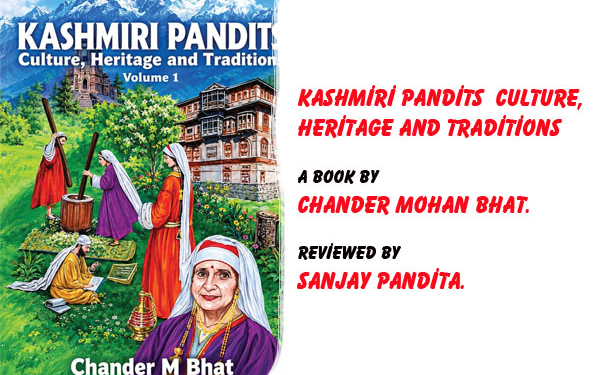
Farooq tantary cniA Cultural World Rediscovered…..Some books preserve information; others preserve memory. Chander Mohan Bhat’s Kashmiri Pandits: Culture, Heritage and Traditions, spread across 462 pages and encompassing more than three hundred subjects, belongs to the latter category.
It is an ambitious and deeply engaging attempt to document not merely the rituals and Sanskaars of the Kashmiri Pandit community, but the texture of an entire way of life—a world expressed through its ceremonies, flowers, birds, fruits, household objects, food, traditional pickles, marriage customs, thread ceremonies and countless other details that once formed the natural vocabulary of everyday existence.The value of the book lies precisely in this breadth. Culture is not created only in temples or preserved in scriptures. It lives equally in the kitchen, the courtyard, the garden and the household; in the objects handled every day, the foods prepared according to season, the ceremonies observed at significant moments of life and the names given to things that were once so familiar that nobody thought it necessary to record them.
Bhat has recognised the importance of these seemingly ordinary details and brought them together in a work that can be read as a portrait of a civilisation in its intimate, lived form.At the heart of the book is the author’s effort to rediscover the Sanskaars and traditional practices that shaped the life of Kashmiri Pandits. But the book does not stop at describing a ritual. It attempts to place these practices within their cultural setting and, wherever possible, to preserve the knowledge associated with them. This is important because a ritual separated from its meaning can eventually become an empty form. The Sanskaars represented stages of human life accompanied by ideas of refinement, responsibility, family, social order and spiritual awareness. To record them is therefore to preserve not only ceremonies but the philosophy of life that lay behind them.Yet it is the book’s movement beyond formal ritual that makes it particularly distinctive. Bhat turns his attention to the natural and material world that surrounded Kashmiri Pandit life. The flowers and birds he records belong to the landscape of an earlier Kashmir; the fruits recall seasonal rhythms and household practices; traditional household articles speak of ways of living that have gradually been altered or replaced. Many of these things were once too ordinary to be regarded as heritage. Their very familiarity made them invisible. It is only when they begin to disappear that we realise that they too were carriers of memory.
The same is true of food. Traditional Kashmiri pickles and other culinary practices may appear at first to be peripheral to a discussion of culture, but they are an intimate expression of it. Food preserves the memory of seasons, kitchens, family habits and inherited knowledge. A particular preparation can evoke an entire household; a taste can bring back a season or a festival; a recipe passed from one generation to another can contain more cultural history than a formal description ever could. By including such material, Bhat widens the meaning of heritage and makes the book a record of lived culture rather than merely ceremonial culture.Marriage customs receive similar attention. The traditional Kashmiri Pandit wedding was not confined to the principal ceremony itself; it unfolded through a series of observances before and after the wedding, each occupying its own place in the social and ritual order. By documenting these practices, along with thread ceremonies and other rites of passage, the author preserves a social world in which important transitions in human life were accompanied by a rich network of customs, relationships and meanings.
For younger readers who may have encountered only fragments of these practices, such documentation can be especially illuminating.This comprehensive approach gives the book an unusual character. It is simultaneously a record of religious practice, social custom, material culture, food tradition and the natural environment. The seemingly disparate subjects—Sanskaar, marriage ceremony, thread ceremony, pickle, household object, fruit, flower or bird—begin to acquire a relationship when viewed together. They are individual pieces of the same cultural mosaic.The need for such documentation becomes more compelling in the context of migration. When the Kashmiri Pandit community left the Valley, the rupture was not only geographical.
The everyday environment through which cultural knowledge had traditionally passed from one generation to another was also disrupted. Earlier, much of this knowledge was acquired without formal teaching. Children watched elders perform rituals, heard traditional expressions, recognised objects in the household, tasted seasonal preparations and grew up surrounded by the landscape that gave meaning to many of these practices. After migration, that natural chain of transmission became increasingly fragile.
Consequently, what had once been lived began to require conscious remembrance.This is where Bhat’s work assumes its larger significance. He has gathered knowledge that might otherwise remain scattered in individual memories and family recollections and has given it a durable form. His book can thus be read as an attempt to arrest the quiet disappearance of cultural vocabulary—the names, practices, objects, ceremonies and customs that tell a people who they are and how their ancestors lived. CNI NEWS