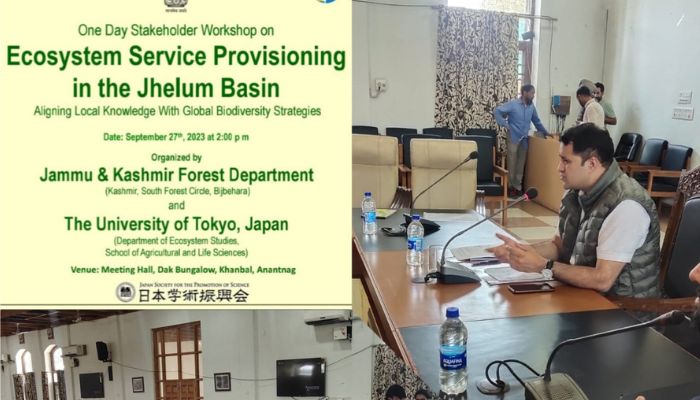
Srinagar, September 27 (CNI) Today Jammu and Kashmir Forest Department organised an collaborative Stakeholders Workshop on Provisioning of Ecosystem Services at Dak Bunglow Anantnag. The program was organised in collaboration with University of Tokyo, Japan and Department of Environment Ecology and Forests as part of ongoing Gandhi Jayanti celebrations
The Conservator of Forests South Kashmir Irfan Ali Shah in his keynote address informed that the workshop aimed to brief participants on biodiversity and ecosystem services, identify current barriers to understanding and assessing biodiversity risks, and the tools available for managing them. He said that the Forest Department is professionally managing the forest ecosystems, conservation of biodiversity, and protection of endangered species of flora, fauna and fragile ecosystems of J&K in a participatory manner along with local communities and other stakeholders in line with the National as well as J&K Forest Policies. He added that this stakeholders workshop gave rise to some vibrant discussions around the theme of financial sector engagement in biodiversity and ecosystem services. He said that the outcomes resulting from this workshop will provide concrete steps forward for mapping out a clear path for achieving the Biodiversity based deliverables set up by the Government for the Forest Department.
Dr Majid, Senior Scientist, Department of Environment, Ecology and Forests in his inaugural address said that “coherent environmental management is key to the ecosystems approach and strong interdisciplinary collaboration between sectors, working at larger scales and joining up across the landscape is necessary. This will also draw on the Government’s ambitions around the Big Society, with close interaction of governments and stakeholders at the local level”. He said “There are challenges in provisioning of Ecosystem services which include the effective communication of the importance of ecosystems services, and their complexities, in order to reach a widespread recognition of the true value of ecosystem services, preventing conflicts between business and the environment and encouraging engagement. However this is complicated by current knowledge gaps, in particular monitoring and evaluating the impacts of ecosystem services on society. Another challenge is linking long and short-term goals”.
Dr Gowhar Mehraj, Ecology Expert, University of Tokyo in his address said” that Indus River System is world’s largest river basins. There were several river systems on the Indian subcontinent long before there were any civilizations. The Indus River System is one such system of rivers. He said that the Indus River System, which consists of the Indus, Jhelum, Chenab, Ravi, Beas, and Satluj, is made up of the principal tributaries of the Indus River. He further said that in India, the Indus exclusively runs through the Leh area of Jammu & Kashmir. A spring at Verinag, which is located at the base of the Pir Panjal in the southern portion of the Kashmir valley, gives rise to the Jhelum, a significant Indus tributary.
About thirty invited officers and officials representing different Government Departments including from Forest Protection Force, Social Forestry, Mining and Geology, PHE, R&B etc, financial institutions like J&K Bank, NGOs, Civil society groups participated in the day long workshop.