Says border villages now at centre of development; highlights improved connectivity, reduced migration, rising incomes, women-led rural economy and strengthened security infrastructure
Ishfaq gulzar cni
Jammu, CNI NEWS: The Jammu and Kashmir Lieutenant Governor Manoj Sinha on Thursday said border villages are the “frontline of India’s identity” and asserted that the government is committed to making them self-reliant, secure and economically vibrant, while highlighting major development gains under the Vibrant Villages Programme.
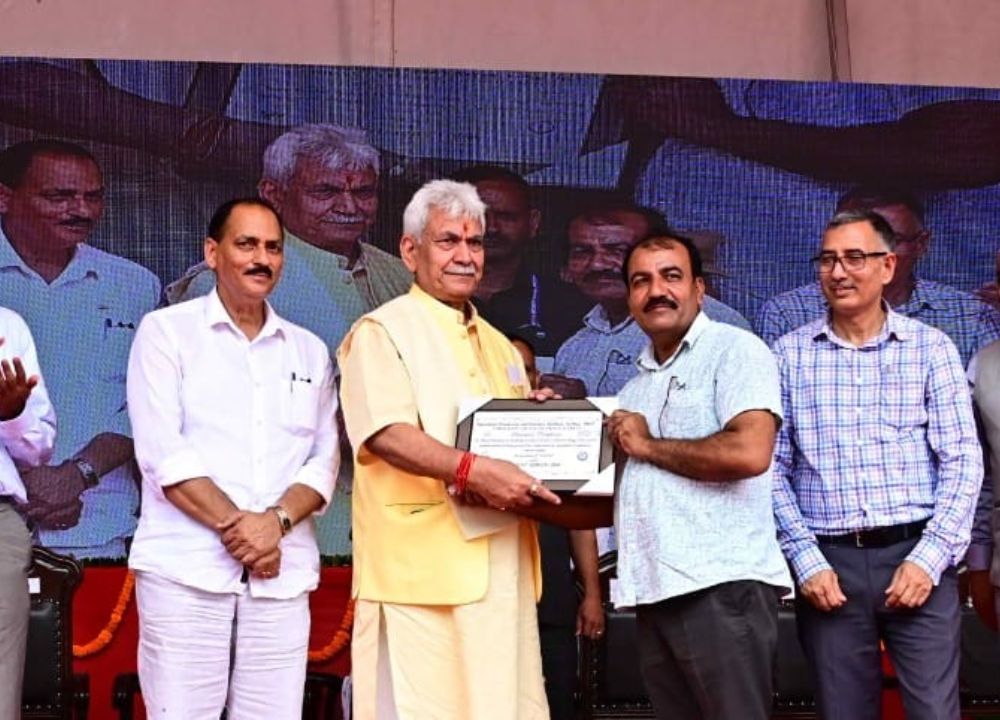
LG Sinha as per news agency CNI NEWS, visited Karol Krishna, a border village in Kathua district. The village along with Rathua, Gujjar Chak, Gajnal, Bobiya, Kadiyala comes under the Vibrant Village Programme-Phase-2 (VVP-2). The Lieutenant Governor handed over benefits under several government schemes to local families and appointment letters to youth.
Addressing the residents from 6 strategic villages under VVP-2, the Lieutenant Governor emphasized that border villages are not India’s last villages, but its first villages, the frontline of the nation’s identity and development.
He noted that for decades, the word “border” carried a sense of distance and these villages were far from the priorities of governance. However, under the leadership of Hon’ble Prime Minister Shri Narendra Modi, border villages have been brought into the mainstream of development.
“When the story of India’s development is written, its first chapter should begin in villages like Karol Krishna, Rathua, Gajnal, Bobiya, Kadiyala and Gujjar Chak, where India’s border breathes and the tricolour flutters,” he said.
Highlighting progress since 2019, the Lieutenant Governor stated that all 216 border villages of Kathua district are now connected by road, with full electrification achieved. Telecommunication and television access, once limited, now reach every household.
“These figures are not just numbers and reports but they represent real change in your lives,” the Lieutenant Governor said.
The Lieutenant Governor shared data highlighting that poverty levels have declined sharply, migration to cities has halved, and rural incomes have risen by 30%. Employment opportunities have expanded, with unemployment reduced to nearly half of earlier levels. More than 2,000 individual and community bunkers have been constructed for the safety of border families.
“Our goal should be that the entire population moves above the poverty line,” he said.
The Lieutenant Governor also commended the role of Nari Shakti in transforming border economies. Under the National Rural Livelihood Mission, over 1,300 self-help groups have been formed, benefiting more than 12,000 families. Women are engaged in tailoring, embroidery, crafts, and small enterprises, strengthening both household and village economies. The Lieutenant Governor also urged the young generation of border villages to dream as big as those in metro cities. He noted that government schools now have improved facilities, digital classrooms, vocational training and full academic sessions.
“This is not a minor change but it is a generational transformation,” he said.
The Lieutenant Governor outlined four key resolves for the development of border villages- Self-reliance by Connecting villages not just to roads but to markets, promoting horticulture and dairy cooperatives. Youth empowerment by creating opportunities in agriculture, tourism, defence-support services, and crafts. Improved health facilities by strengthening healthcare and tele-medicine connectivity, and the fourth resolve is robust security infrastructure by enhancing coordination between civil administration and armed forces.