Ishfaq gulzar cni
India has , in recent years, emerged as the world’s largest Vaccine producer and global supplier by volume , while India’s diverse disease landscape, combined with its expanding scientific capabilities, provides a unique platform for Vaccine research, epidemic preparedness and the development of biomedical solutions for global health, Union Minister of State (Independent Charge) for Science & Technology and Earth Sciences and MoS PMO, Personnel, Public Grievances, Pensions, Atomic Energy and Space, Dr. Jitendra Singh, said today.The Minister said, India has moved far beyond the limitations of a decade ago in epidemic preparedness and
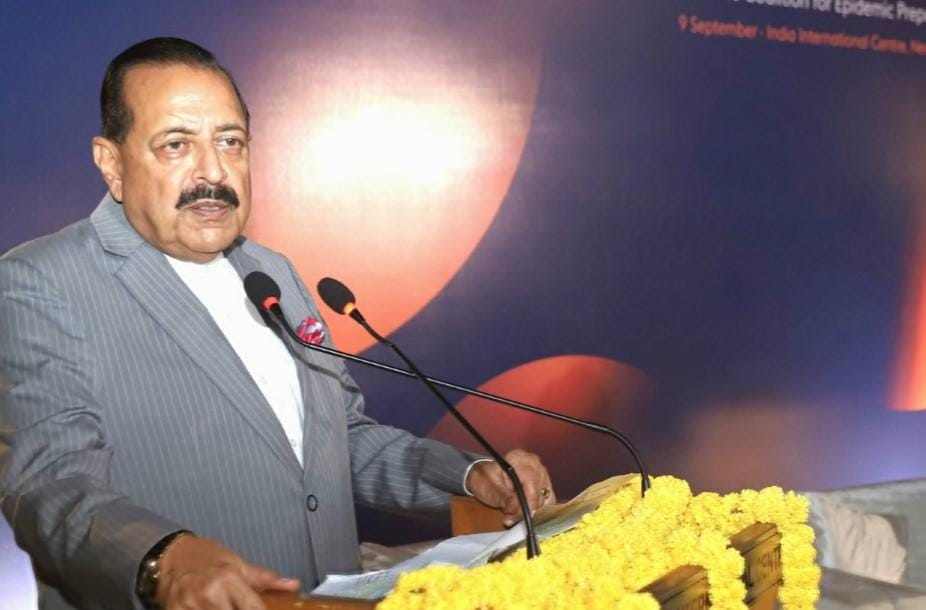
has built a vibrant bioeconomy, strong vaccine development capabilities and a scientific ecosystem capable of contributing to the world’s preparedness for future epidemics and pandemics.Dr. Jitendra Singh was speaking at a High-Level Evening Reception for the “Coalition for Epidemic Preparedness Innovations” (CEPI) Board and Investors Council, jointly hosted by the Department of Biotechnology (DBT), Government of India, and the CEPI at India International Centre, New Delhi. The reception brought together CEPI’s leadership, Board and Investors Council members, policymakers, scientists,
industry representatives and other stakeholders engaged in vaccine development and epidemic preparedness. The CEPI Board and Investors Council meetings in New Delhi come a decade after the previous governance meeting was held in India, reflecting the depth of the India-CEPI partnership.Congratulating CEPI and its partners on the occasion, Dr. Jitendra Singh said India’s association with CEPI goes back to its formative years, with India as a founding member and a long-standing strategic partner. He also acknowledged the contribution of scientists and institutions that have helped build India’s vaccine and biomedical capabilities, including the teams led by senior scientific leaders such as Dr. Rajesh Gokhale, and the wider scientific fraternity.The Minister said the progress made by India in the last decade represents a significant transformation in both epidemic preparedness and biotechnology. He said the country is today a vibrant bioeconomy and its capabilities can no longer be viewed only through the prism of vaccine manufacturing. India has moved into advanced vaccine technologies and complex biological products, supported by domestic research, manufacturing and clinical
capabilities.India’s bioeconomy reached USD 195.3 billion in 2025, recording 18 per cent year-on-year growth, while the country’s biotech startup ecosystem expanded to 11,855 startups, including 1,780 new startups added in 2025 alone. The biopharma sector accounts for nearly 30 per cent of India’s bioeconomy.Dr. Jitendra Singh said India’s transformation is particularly visible in the vaccine sector. From being known primarily for affordable vaccine manufacturing, India has developed capabilities across the value chain, from research and innovation to advanced biologics development and large-scale manufacturing. India supplies vaccines to more than 100 countries, accounts for nearly 60 per cent of global vaccine production and meets more than 65 per cent of WHO’s routine immunization requirements.Recalling the COVID-19 experience, he said India not only developed vaccines in a remarkably short period but also extended them to other countries and partners. This journey, he said, has contributed to a significant change in the global perception of India’s scientific and technological
capabilities.The Minister said the country’s strength lies not merely in its manufacturing scale but also in the unique scientific opportunities created by India’s heterogeneous disease landscape. India continues to face a wide spectrum of communicable diseases while simultaneously dealing with the growing burden of non-communicable and metabolic disorders. This creates a dual challenge for preparedness, but also provides a rich scientific environment for understanding pathogens, disease patterns and interactions between infectious and metabolic conditions.Dr. Jitendra Singh recalled that
international researchers had historically come to India to study viruses, bacteria and diseases that were not readily found in their own countries. The same diversity, he said, can now become a strategic scientific advantage for India as it builds modern capabilities in pathogen research, vaccine development and epidemic preparedness.“India provides such a fascinating research area” because of the combination of the diversity of microbes present in the country and the depth of scientific talent available to study them, Dr. Singh said. He said the country has an opportunity to contribute not only to its own
preparedness but also to enriching the global repository of knowledge and biomedical solutions.The DBT-BIRAC-CEPI partnership provides an important platform for translating this scientific potential into vaccines and other biomedical interventions. DBT and BIRAC have been working with CEPI under a tripartite engagement strategy aimed at strengthening preparedness for future epidemics and pandemics and advancing India’s R&D capabilities in vaccines for emerging infectious diseases. The engagement strategy, first executed in October 2019, was renewed in September 2025 for another five years. CNI NEWS