Tariq khan cni
Srinagar, (CNI NEWS): The Jammu & Kashmir Judicial Academy, under the patronage of Hon’ble Mr. Justice Sanjeev Kumar, Chief Justice (A), High Court of Jammu & Kashmir and Ladakh, and under the guidance of Hon’ble Mr. Justice Rajnesh Oswal, Judge, High Court of J&K and Ladakh and Chairman, Governing Committee, J&K Judicial Academy, organized a one-day workshop on “Arbitration & Conciliation Act, 1996; Mediation: Role of Judges in Referral with Special Reference to the Mediation Act, 2023” at the J&K Judicial Academy, Mominabad, Srinagar.
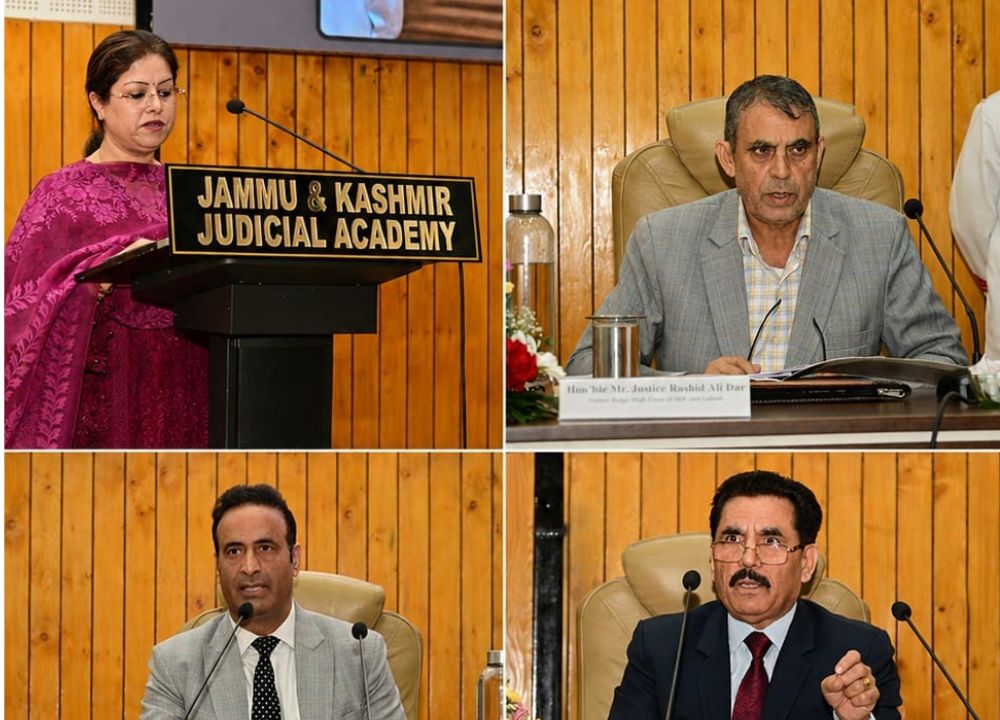
The workshop commenced with the inaugural address by Hon’ble Ms. Justice Moksha Khajuria Kazmi, Judge, High Court of J&K and Ladakh and Member, Governing Committee, J&K Judicial Academy.
In her address, Justice Kazmi emphasized that while adjudication remains central to the rule of law, arbitration, conciliation and mediation are important dispute-resolution mechanisms suited to the nature and circumstances of individual disputes. She observed that mediation provides parties an opportunity to participate in shaping the resolution of their disputes, thereby fostering greater ownership and commitment towards settlement.
Her Ladyship stressed that the success of mediation should not be measured merely by the number of cases disposed of, but also by the sustainability and effectiveness of settlements. She underscored the importance of trained mediators, appropriate judicial referrals and institutional support to strengthen the mediation process.
The first technical session was conducted by Hon’ble Mr. Justice Rashid Ali Dar, Former Judge, High Court of J&K and Ladakh, on “Arbitration: Basic Principles, Court’s Role and Interface with Judicial Proceedings.” He explained the fundamental principles governing arbitration and emphasized the need to maintain a balance between party autonomy and minimal judicial intervention.
Justice Dar highlighted that courts should facilitate rather than obstruct arbitration while ensuring fairness, legality and adherence to principles of natural justice. The session covered various aspects of the Arbitration and Conciliation Act, 1996, including arbitration agreements, reference to arbitration, appointment and jurisdiction of arbitral tribunals, interim measures and the complementary roles of courts and arbitral tribunals.
Thereafter, Mr. Mohan Singh Parihar, Former District and Sessions Judge, conducted sessions on “Mediation – Role of Judges in Referral and Facilitation of Settlement” and “Mediated Settlements – Recording, Enforcement, Challenges and Implementation.”
Mr. Parihar provided practical insights into the role of judicial officers in identifying cases suitable for mediation. He emphasized that before referring a matter to mediation, the court should understand the facts and nature of the dispute and assess whether the dispute contains an element that can appropriately be resolved through settlement.
He also explained the procedural framework governing mediation, including referral to District Mediation Centres, the role of mediators and the procedure to be followed in both successful and unsuccessful mediations. He highlighted the importance of considering ADR at the appropriate stage of judicial proceedings and explained the objectives of Section 89 of the Code of Civil Procedure.