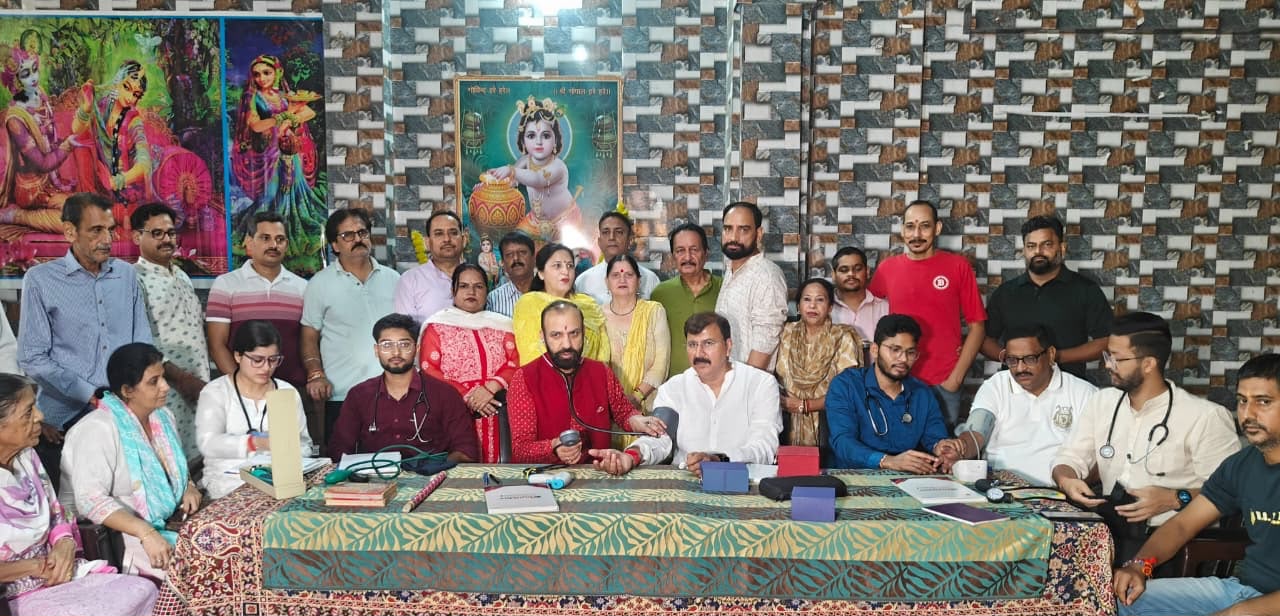
Tariq khan cniJammu, CNI NEWS: Underscoring the need to make heart health a priority from an early age, Head Department of Cardiology, GMCH Jammu, Dr Sushil Sharma held a day-long Cardiac Awareness-cum-Health Check-up Camp at Hari Mandir, Rehari Colony, Jammu.
The initiative was aimed at sensitizing the community about the rising prevalence of cardiovascular ailments and the crucial role of prevention in curbing heart-related morbidity and mortality. Addressing the participants, Dr Sushil observed that cardiovascular disease often develops silently over several years, with the underlying process of arterial plaque formation potentially beginning much earlier than the appearance of clinical
symptoms. He stressed that timely screening and health-conscious living can play a decisive role in safeguarding cardiovascular well-being. Dr Sushil pointed out that conventional cardiovascular risk assessment remains an important component of preventive healthcare, but its predictive ability may be limited among younger people. Since age is a significant component of most short-term risk calculations, younger individuals can sometimes receive reassuring risk estimates despite harbouring important risk factors or inherited susceptibility. He cautioned that an apparently favorable short-term assessment should not create a false sense of security, particularly in those having hypertension, abnormal cholesterol, obesity, diabetes, tobacco exposure or a family history of premature heart disease. According to him, identifying such vulnerabilities at an early stage can provide valuable time to modify harmful influences and prevent or delay the progression of cardiovascular disease. Explaining the potential of newer approaches, Dr Sushil highlighted the complementary importance of cardiovascular imaging and polygenic risk scores (PRS) in refining early risk identification. Imaging can provide a visual assessment of the arteries and may detect atherosclerotic plaque even in individuals who have no obvious symptoms. Evidence of plaque can offer a more tangible indication of ongoing vascular disease and may encourage people to adopt healthier habits and follow preventive treatment more diligently. Polygenic risk scores, on the other hand, assess the cumulative influence of numerous genetic variants associated with cardiovascular susceptibility. Such information may help recognize individuals carrying a greater inherited predisposition, even when their conventional clinical profile appears relatively favourable.
The combination of these approaches could therefore add another dimension to personalized cardiovascular prevention. Dr Sushil clarified that advanced assessment methods should strengthen, rather than substitute, established preventive practices. Genetic susceptibility represents a predisposition and not a predetermined outcome, while a normal imaging assessment at one point in life cannot ensure protection against future disease. Cardiovascular health is shaped by a complex interaction between heredity, lifestyle, metabolic factors and environmental influences. He therefore advocated a sustained focus on blood pressure control, healthy lipid levels, maintaining an appropriate body weight, regular physical
activity, nutritious food choices, adequate sleep, stress reduction and complete avoidance of tobacco. During the camp, members of the public were also encouraged to undergo periodic health evaluations and seek medical advice promptly whenever risk factors or warning symptoms emerge. In concluding remarks Dr Sushil said that the central objective of modern preventive cardiology should be to recognize vulnerability before it culminates in a cardiovascular event.
He maintained that combining sound clinical judgement with appropriate screening, imaging and emerging genetic tools could enable healthcare professionals to identify risk earlier and formulate more individualized prevention strategies. He also emphasized that prevention should not be viewed as a one-time intervention but as a lifelong commitment to healthier choices. The awareness and screening camp at Hari Mandir provided an important community platform for spreading this message and reinforcing the principle that a healthy heart is best protected through early awareness, regular monitoring and timely action. Prominent members of the area, including Ashwani Suri, Sanjay Bali, Saudaghar Gupta, Surinder Choudhary (Ex-Corps), Renu Choudhary, Anu Bali (Ex-Corps), Naveen Bali (Ex-President), Kishore Sharma and Rajesh Dutta, appreciated Dr Sushil and his tea for organizing the cardiac awareness cum health check up camp. They expressed gratitude for providing accessible cardiac screening and preventive health care services. MLA West Shri Arvind Gupta also graced the
occasion. Others who were part of this camp included Dr. Bhola Kumar, Dr. Ajay Aditya Kerni, Dr. Rajesh Gupta (Paed), Dr. Aditya Sharma, Dr. Divyanshi Sharma and Dr. Dushyant Sharma. Paramedics and volunteers included Amnish Datta, Rajinder Singh, Sudhir Bharti , Shubham Sharma, Makhan Sharma, Mukesh Kumar, Rahul Vaid , Harpreet Singh, Vikas Kumar, Narinder Datta and Nirvair Singh Bali. CNI NEWS